Analytical Methods4 min read
D- and L-Amino Acids in Peptides: Evaluating Chiral Analysis
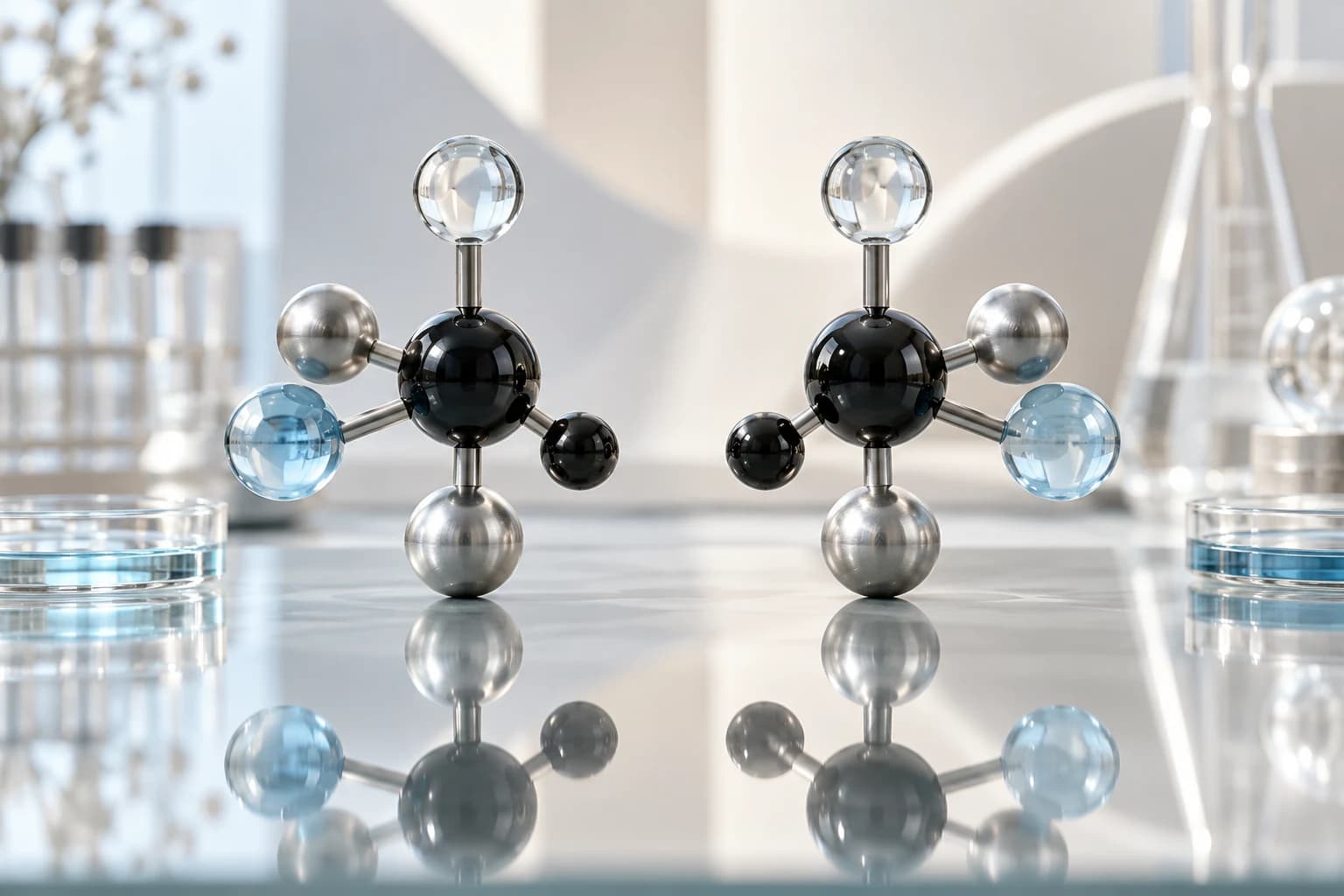
Peptide chiral analysis investigates amino acid stereochemistry. That question is not answered simply by matching the expected molecular mass: different stereochemical forms can share the same composition while differing in three-dimensional arrangement.
Peptide chiral analysis investigates amino acid stereochemistry. That question is not answered simply by matching the expected molecular mass: different stereochemical forms can share the same composition while differing in three-dimensional arrangement.
For a laboratory study involving a specified D- or L-residue, the analytical goal should be explicit. The team may need to establish whether a stereochemical form is present, estimate a mixture, or assign that stereochemical form to a particular position in the sequence. Those are different claims.
State the stereochemical question precisely
Write the intended stereochemical form alongside the relevant residue numbers. Preserve any uncertainty in the starting specification rather than silently converting a shorthand sequence into a fully assigned structure.
If a sequence contains the same amino acid at several positions, a total amino acid composition result may not indicate which occurrence had a particular stereochemical form. Position assignment can require additional evidence.
Use the site's sequence and modification guide to organize the molecular specification, then add the exact stereochemical question the laboratory is being asked to test.
Understand what derivatization-based analysis can reveal
Some approaches hydrolyze the peptide and derivatize the resulting amino acids so stereochemical differences can be evaluated chromatographically. The analytical comparison depends on appropriate reference information and the method's demonstrated separation capability.
An original study of peptide chiral purity by LC-MS addressed a central complication: hydrolysis itself can alter the D/L ratio through racemization. Its design used deuterated conditions to investigate that problem. This is evidence that preparation matters, not a universal preparation recipe.
Ask how the chosen method distinguishes a property of the original sample from a change introduced during analysis.
Avoid assigning sequence position from incomplete evidence
Total hydrolysis removes the original chain order. If the sample contains repeated residues, identifying both stereochemical forms among released amino acids may leave their locations in the intact peptide unresolved.
Research on C3 and two-dimensional Marfey's methods illustrates analytical strategies for more demanding stereochemical and positional questions. The important lesson is to match the claim to the evidence, rather than treating every chiral chromatogram as a complete sequence-level assignment.
In a hypothetical peptide with two leucine residues, a result showing mixed stereochemical forms could justify further investigation. It would not, by itself, identify which leucine position carried which stereochemical form.
Review separation and reference matching
Check how peaks were identified, which reference materials were used, and whether the relevant alternatives were demonstrably distinguishable under the method conditions. Retain chromatograms and assignment tables together.
A result near the method's quantification limit should carry the appropriate qualification. Do not convert a tentative trace observation into a precise stereochemical percentage without the supporting analytical performance.
When several methods are combined, explain the role of each. One may support overall composition, another the presence of a stereochemical form, and another its location. The combined conclusion should show how those pieces connect.
Report both the finding and its scope
A clear report names the tested sample, the preparation, the measured amino acids, the supported stereochemical form assignments, and any unresolved positions. It should also describe relevant limitations caused by hydrolysis, separation, or available references.
The practical decision might be to accept a supported assignment, retain a qualified interpretation, or request additional structural work. Making that decision explicit is more useful than appending a general “confirmed” label to a complex result.
For material-related inquiries, contact Peptide Wholesale Supply about the specific documentation available. General analytical purity or an intact mass result should not be assumed to include a dedicated chiral analysis.
Related reading
Continue with Peptide MS/MS Sequence Coverage: What Fragment Ions Establish; Disulfide Mapping in Peptide Research: Testing Cysteine Connectivity; Amino Acid Analysis for Peptide Content: What the Measurement Means.
For in vitro laboratory research use only. Not for human or animal use or consumption. Not for diagnostic or therapeutic use.