Assay Development4 min read
Microplate Edge Effects in Peptide Assays
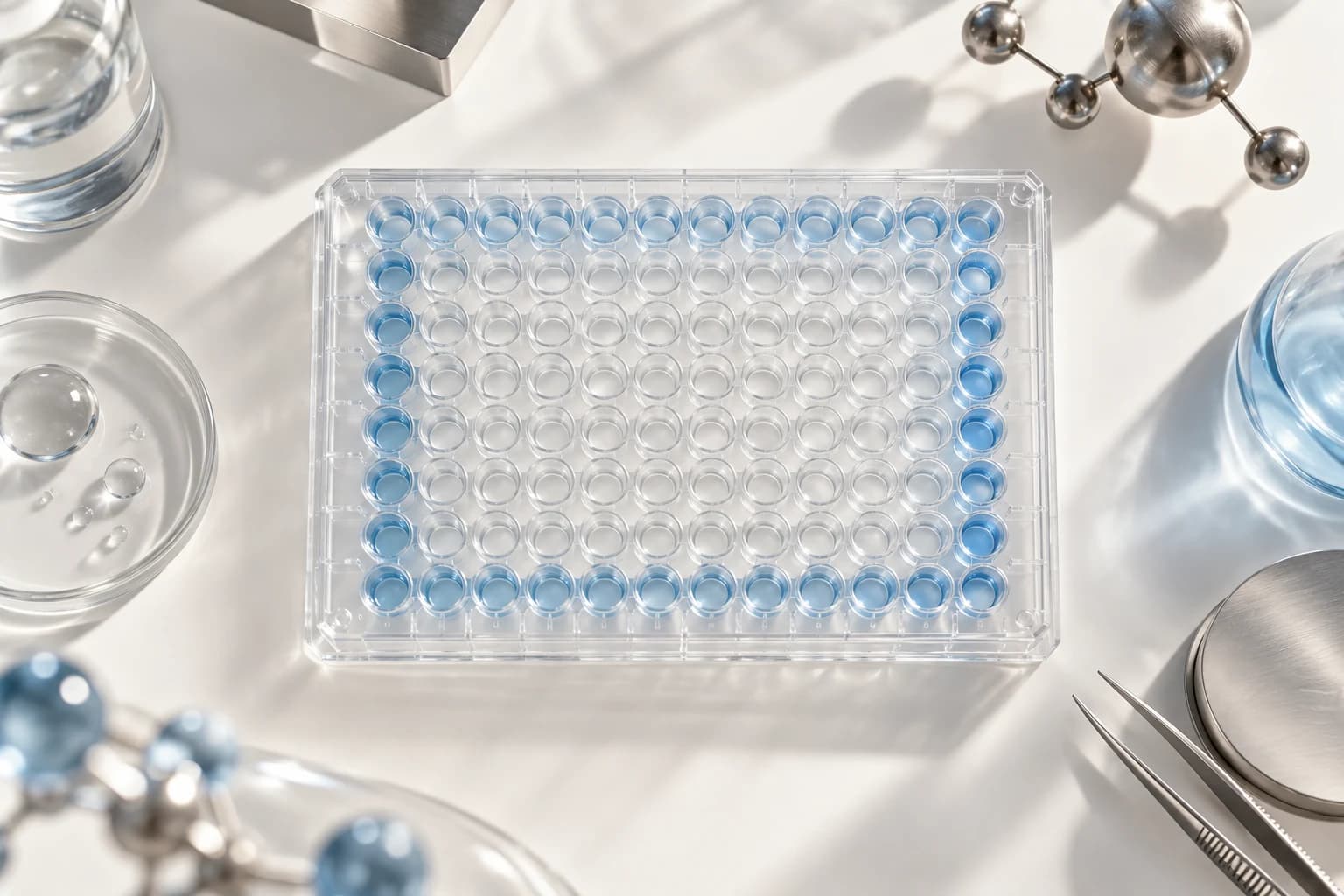
Microplate edge effects can make an assay result depend partly on well position. When one treatment group occupies the outside wells and another occupies the center, a spatial pattern may be mistaken for a difference between materials. The first defense is a plate design that makes position visible in the data.
Microplate edge effects can make an assay result depend partly on well position. When one treatment group occupies the outside wells and another occupies the center, a spatial pattern may be mistaken for a difference between materials. The first defense is a plate design that makes position visible in the data.
For peptide experiments, plate behavior belongs in method development alongside sample preparation and detection. A consistent material does not guarantee consistent results if the assay environment varies across the plate.
Look at the plate before averaging the groups
Plot the raw results by well position. A heat map or clearly labeled plate map can reveal row, column, or perimeter patterns that disappear in group averages. Review reference controls and background measurements using the same view.
The Assay Guidance Manual chapter on microplates discusses plate uniformity, positioning, surfaces, and other experimental considerations. Its central relevance is that the plate is part of the assay system, not just a container.
Preserve well identifiers in exported data. Removing them early makes later investigation unnecessarily difficult.
Avoid confounding treatment with position
Consider a hypothetical experiment in which all samples from Material A occupy perimeter wells and all samples from Material B occupy central wells. If the perimeter behaves differently, the design cannot cleanly separate a material difference from a position effect.
A better plan distributes the comparison in a way that allows the laboratory to assess spatial influence. The exact arrangement depends on the assay and workflow. Randomization, blocking, or balanced placement may help when used deliberately.
Control placement also matters. Controls located only in one region may fail to characterize the rest of the plate. Write the layout rationale before running the experiment.
Investigate uniformity under the intended conditions
A uniformity study asks whether equivalent wells produce comparable results across the plate. Include the actual handling, timing, instrumentation, and environmental conditions relevant to the planned method.
The HTS assay validation guidance includes approaches to identifying spatial patterns. A laboratory should adapt the evaluation to its assay rather than apply criteria from an unrelated screening format without justification.
Assess reproducibility across independent runs. A recurring perimeter pattern and an isolated unusual well suggest different follow-up questions. Record both without letting a summary statistic erase their location.
Check the workflow around the plate
Review timing between dispensing and reading, plate orientation, handling sequence, and any changes in equipment or consumables. Determine whether processing order is also linked to treatment group.
For example, if one group is always prepared first and measured last, a time-dependent effect may overlap with the spatial pattern. The investigation should separate those factors instead of assigning every position-associated result to the plate itself.
Make one informative change at a time where practical. A revised layout plus new consumables plus altered timing may improve performance, but it will not identify which change addressed the issue.
Set rules before excluding wells
Define acceptance criteria and data-handling rules before seeing the treatment results. Removing perimeter wells after they produce an unwanted result risks biasing the analysis. If a run fails its predefined criteria, document the failure and the corrective work.
The method record should preserve the plate layout, raw values, exclusions, and supporting uniformity evidence. Reassess the relevant behavior when a material change in the assay workflow occurs.
For peptide purchases supporting method development, use the catalog to identify the proposed material and contact the team for available specifications. Plate qualification remains specific to the laboratory's assay, equipment, and experimental design.
Continue reading
Explore related research guides: Biological and Technical Replicates in Peptide Experiments; Vehicle Controls in In Vitro Peptide Studies.
For in vitro laboratory research use only. Not for human or animal use or consumption. Not for diagnostic or therapeutic use.